Shock-turbulence interaction
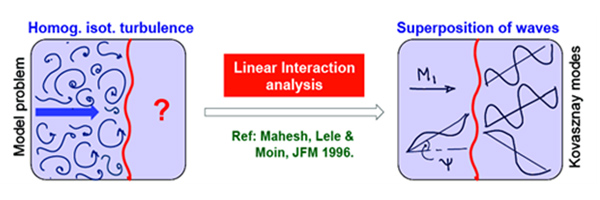
We study shock-turbulence interaction in its simplest form: homogeneous isotropic turbulence passing through a normal shock. The shock amplifies the incoming disturbances and can also generate new kind of fluctuations; the shock itself gets distorted and coupled to the turbulence. We apply a theoretical tool called linear interaction analysis, which is based on ideas developed in the 50s, and the PhD work of Krishnan Mahesh from Stanford gives the full development. The key thing in this theory is to decompose turbulence into the fundamental modes of vorticity, entropy and acoustic waves. In the linear limit, these modes develop independently. But the shock couples them, such that each incident wave generates all three waves downstream. For a set of input parameters, the analysis gives us the amplitude and phase of the waves, and we can then compute quantities of our interest.
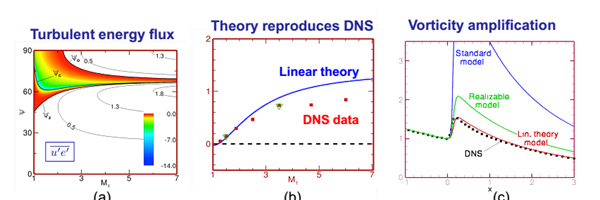
Lately we have been looking at the turbulent energy flux, which represents how turbulent mixing affects internal energy transport and this, in turn, determines heat transfer in a turbulent flow. The figure below (part 'a') shows the correlation