Multi-jet Nozzle Interaction
The clustering of multiple engines and hence exhaust nozzles for thrust generation is a common practice followed in rocket propulsion. At high altitudes, the underexpanded jets coming out from the neighbouring nozzles expand rapidly. The radial expansion of these jets leads to their mutual interaction which can result in exhaust reverse flow towards the rocket engine base. The jet interaction process and the resulting reverse flow is primarily governed by a parameter called nozzle pressure ratio (NPR), which is defined as the ratio of nozzle exit static pressure to free-stream static pressure. As NPR increases, the exhaust reverse flow changes from subsonic to supersonic regime and its impingement on the rocket engine base creates a stagnation region with high values of heat flux and pressure. This can have a significant effect on rocket performance, in terms of drag/thrust and base heating. It is therefore important to understand multi-jet interaction and predict them accurately.
Majority of the experiments to study the multi-nozzle plume interaction and the associated base flow-field have been performed in the 1960s. The main objectives of these tests were to provide base pressure and heating trends due to various changes in geometry configuration and ambient pressure. However, these experimental investigations have been limited to obtaining base surface measurements; consequently, the flowfield and the shock structure has not been analysed in detail and it is difficult to generalize the findings.
CFD simulations of the multi-jet interactions flows are also limited, as modeling of such flows is a challenging task. Majority of these works aim at providing the best CFD practices for multi-plume simulations by studying the effects of mesh resolution, nozzle exit and other boundary conditions, multi-species gas model and single species gas model assumptions on the base pressure and base heat flux.
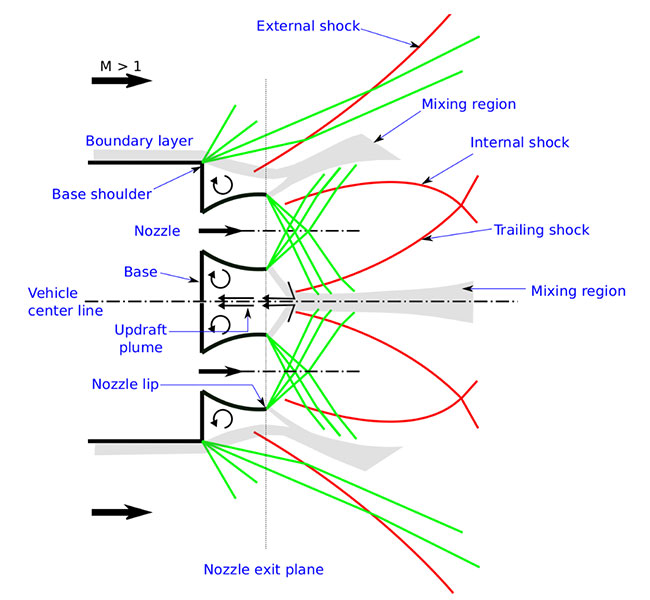
The complexity of the multi-jet interaction flows arises due to various flow structures, flow regimes, and large thermal and momentum gradients within the base region. Such flows span from subsonic to supersonic Mach numbers and consist of a multitude of shocks and expansion waves. There are regions of strong inviscid/viscous interactions involving free shear layers, boundary layers, shocks, separated flow and recirculation regions, and plume/plume interaction. Additionally, the flowfield induced by multiple parallel under-expanded jets can be highly three-dimensional. The complex multi-nozzle configuration and the rocket base require elaborate grid generation and thus CFD simulation of these flows is an exceptionally challenging task. However, three-dimensional Renolds-averaged Navier-Stokes (RANS) simulations still remain a viable option to predict the multi-jet interaction flowfield and the associated base pressure and base heat flux.
In our study of the multi-jet interaction problem, we do elaborate 3D multi-block structured grid generation using the Gridgen (now Pointwise) software. Our objective is to study the flowfield of multi-jet interaction for a four-nozzle rocket system configuration using Reynolds-averaged Navier Stokes (RANS) computations. These include expansion fans generated at the nozzle lip, boundary layer separation at the base shoulder, formation of shock waves inside the jets, as well as in the external flow. A number of viscous and inviscid interactions are identified and their effect on the multi-jet interaction are analysed. Finally, regions of turbulent shear layers interacting with shock waves are identified, and the effect of shock-turbulence physics on the flow field prediction is studied.
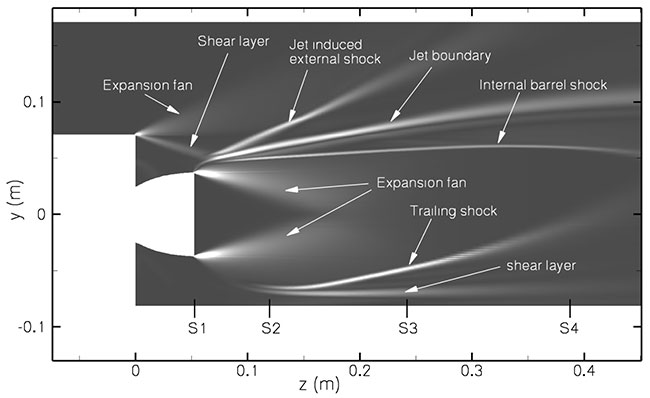
The strength of reverse flow due to multi-jet interaction mainly depends on the level of turbulence in the interacting plume shear layers. Therefore, the prediction of base pressure and base heat flux is sensitive to the choice of turbulence model. The multi-jet interaction flowfield has shock waves interacting with the turbulent plume shear layers and turbulence gets amplified across these shock waves. The turbulence intensity or the level of eddy viscosity in the plume shear layers influences the plume expansion thereby affecting the multi-jet interaction flowfield and the reverse flow. In our study, we apply the physics-based shock-unsteadiness model of Sinha et al. 2003 to this flowfield. The model has shown superior performance over the conventional turbulence models in predicting the interaction of shock waves with turbulence. The model is expected to accurately capture the shock-turbulence interaction in this multi-jet interaction flowfield, thereby improving the results over the conventional turbulence models.