Ventilation studies in classrooms at IIT Bombay using CFD and droplet tracking
The LT 001 room of Lecture Hall Complex 1 has capacity of 60 students. Two exhaust fans have been fitted on wall opposite to the door in pursuit of enhancing the ventilation inside the classroom. Our project deals with identification of primary flow and reversed flow (dead air zone) inside the classroom and to answer the question whether installation of exhaust fans are beneficial or not.
The dead air zone is the recirculation zone where the residence time of the flow is very high. Any potential source of aerosol (that contains the Corona virus) may inject the virus in this dead zone and can possibly infect other students in the classroom whosoever reside in this dead zone.
The project has two aspects i) computational fluid dynamics and ii) Agarbati experiment (incense sticks). The computational part deals with computing the air flow field inside the classroom using ANSYS Fluent. A model of classroom is created with door and exhaust fans. The door is set to pressure inlet, exhaust fans are set to velocity inlet (negative value for the velocity) and no slip boundary condition is set for the walls. The air flow field computation gives a qualitative estimate of size of recirculation zone inside the classroom.
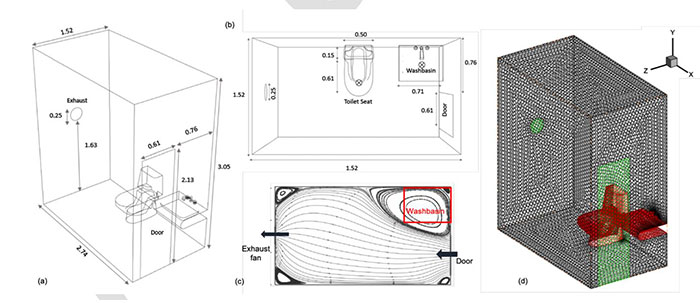
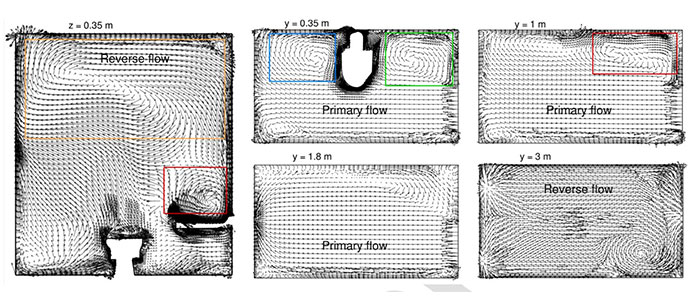
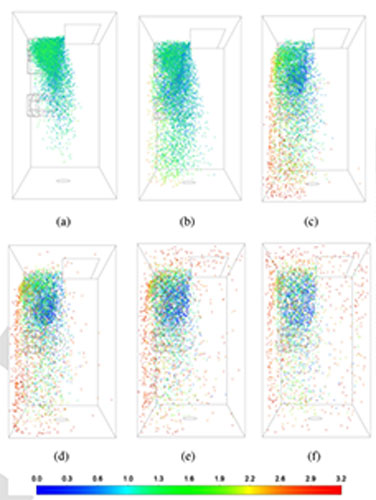
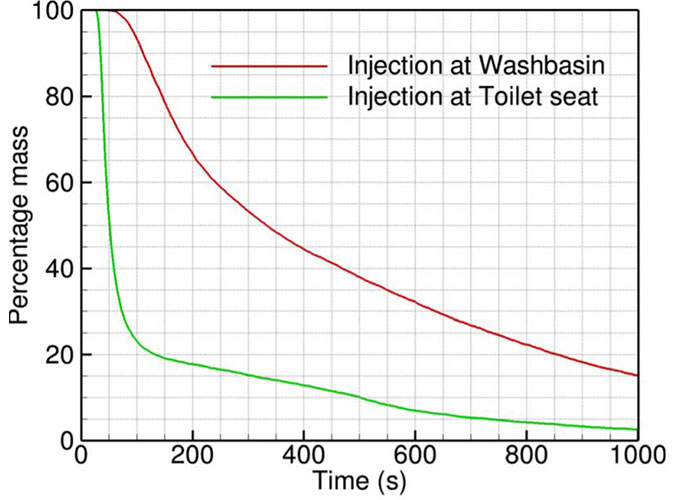
The existence of recirculation zones are validated by performing agarbati experiments at various locations in the classroom. The smoke streak from the agarbati suggests the direction of the local flow field. If the smoke streak is drawn towards the exhaust fans, the flow is primary flow. Primary flow is well ventilated region and is advisable for the students to sit at such locations. If the smoke streak is deflected towards the inlet, there exists a local reverse flow region and should be avoided.