


 |
 |
 |
 |
Shock-Unsteadiness Model Applied to Oblique Shock Wave/ Turbulent Boundary-Layer Interaction
Reynolds-averaged Navier-Stokes prediction of shock wave/turbulent boundary layer interactions can yield significant error in terms of the size of the separation bubble. In many applications, this can alter the shock structure and the resulting surface properties. Shock-unsteadiness modification of Sinha et al. (Physics of Fluids, Vol.15, No.8, 2003) has shown potential in improving separation bubble prediction in compression corner flows. In this article, the modification is applied to oblique shock wave interacting with a turbulent boundary layer. The challenges involved in the implementation of the shock-unsteadiness correction in the presence of multiple shock waves and expansion fans are addressed in detail. The results show that a robust implementation of the model yields appreciable improvement over standard k-omega turbulence model predictions. modelling
Ref: Pasha, Amjad A., and Sinha, K., "Shock-unsteadiness model applied to oblique shock wave/turbulent boundary-layer interaction". International Journal of Computational Fluid Dynamics ,Vol. 22, No. 8, September 2008, 569-582
Representative results:
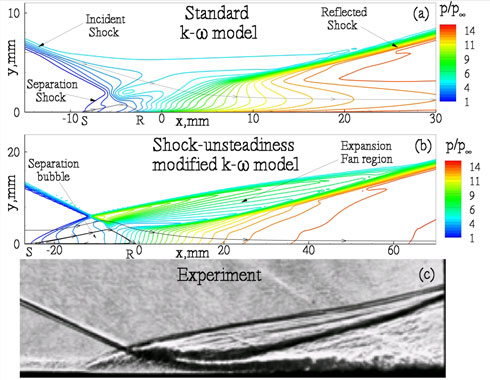
Amplification of turbulent kinetic energy across a normal shock at for different levels of upstream temperature fluctuations.