



 |
 |
 |
 |
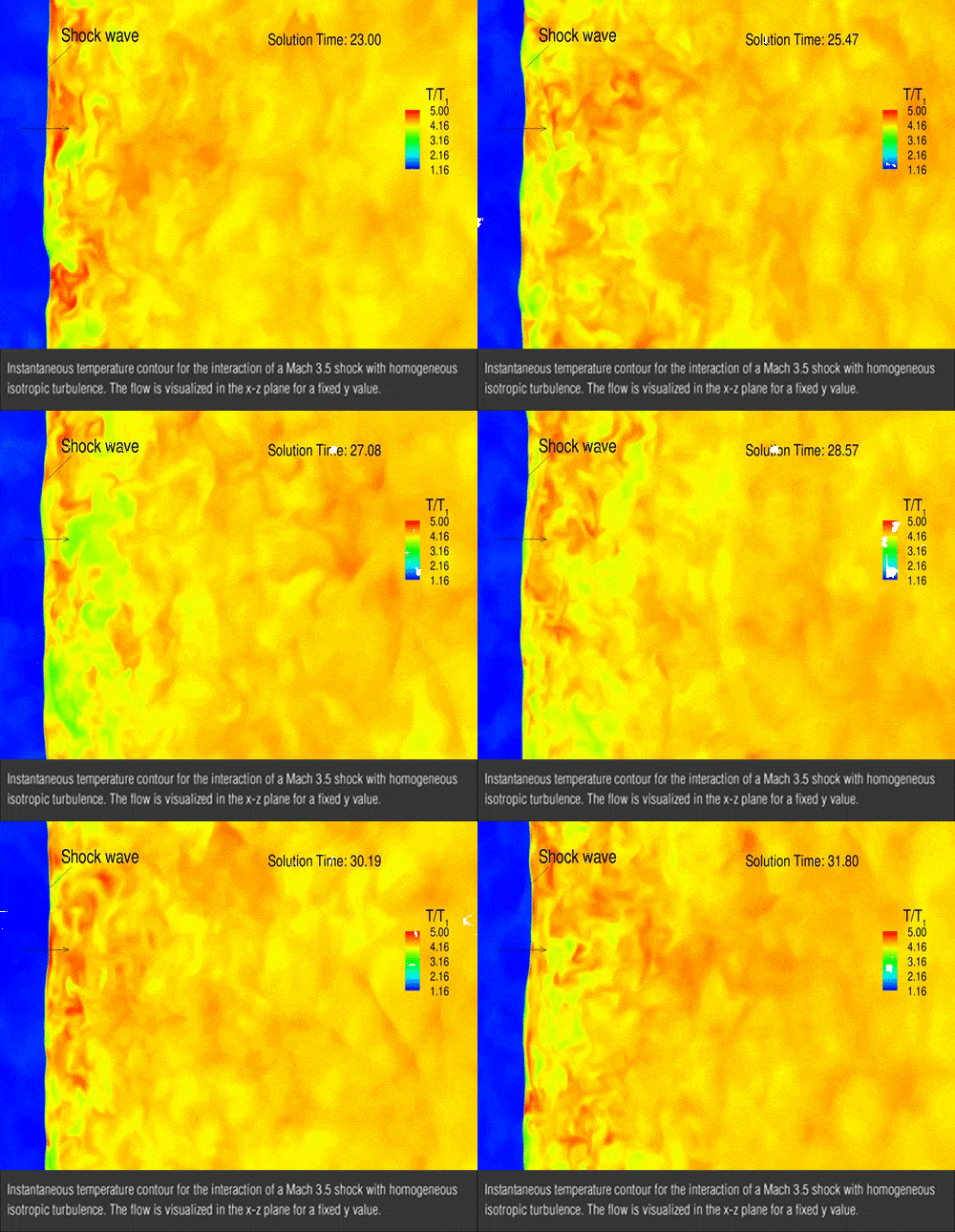
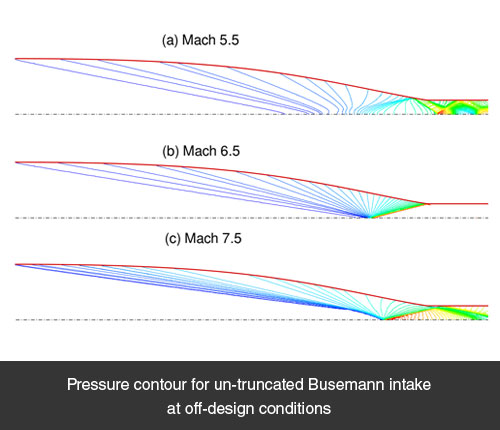
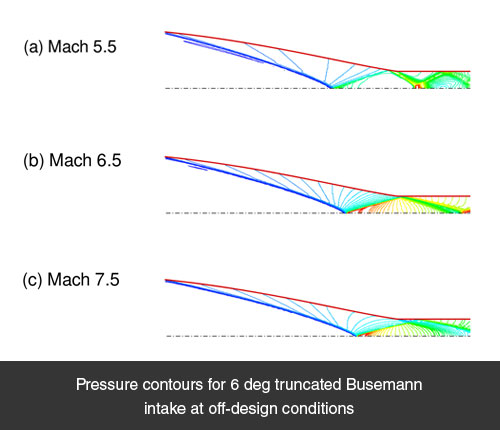
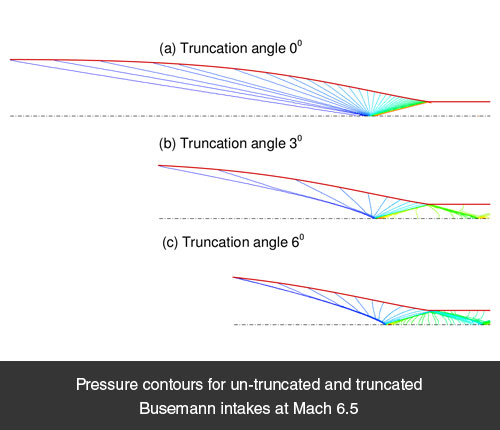
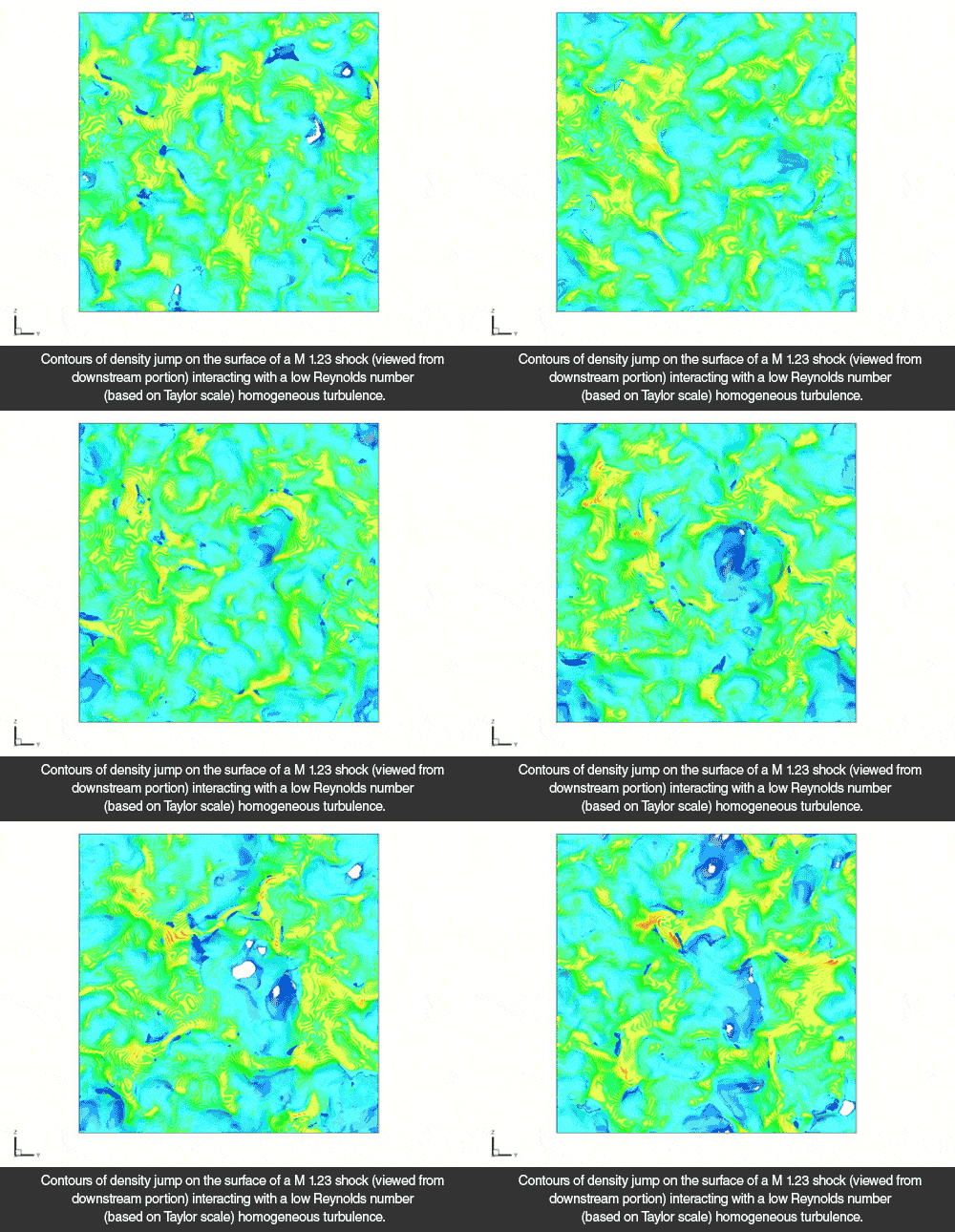
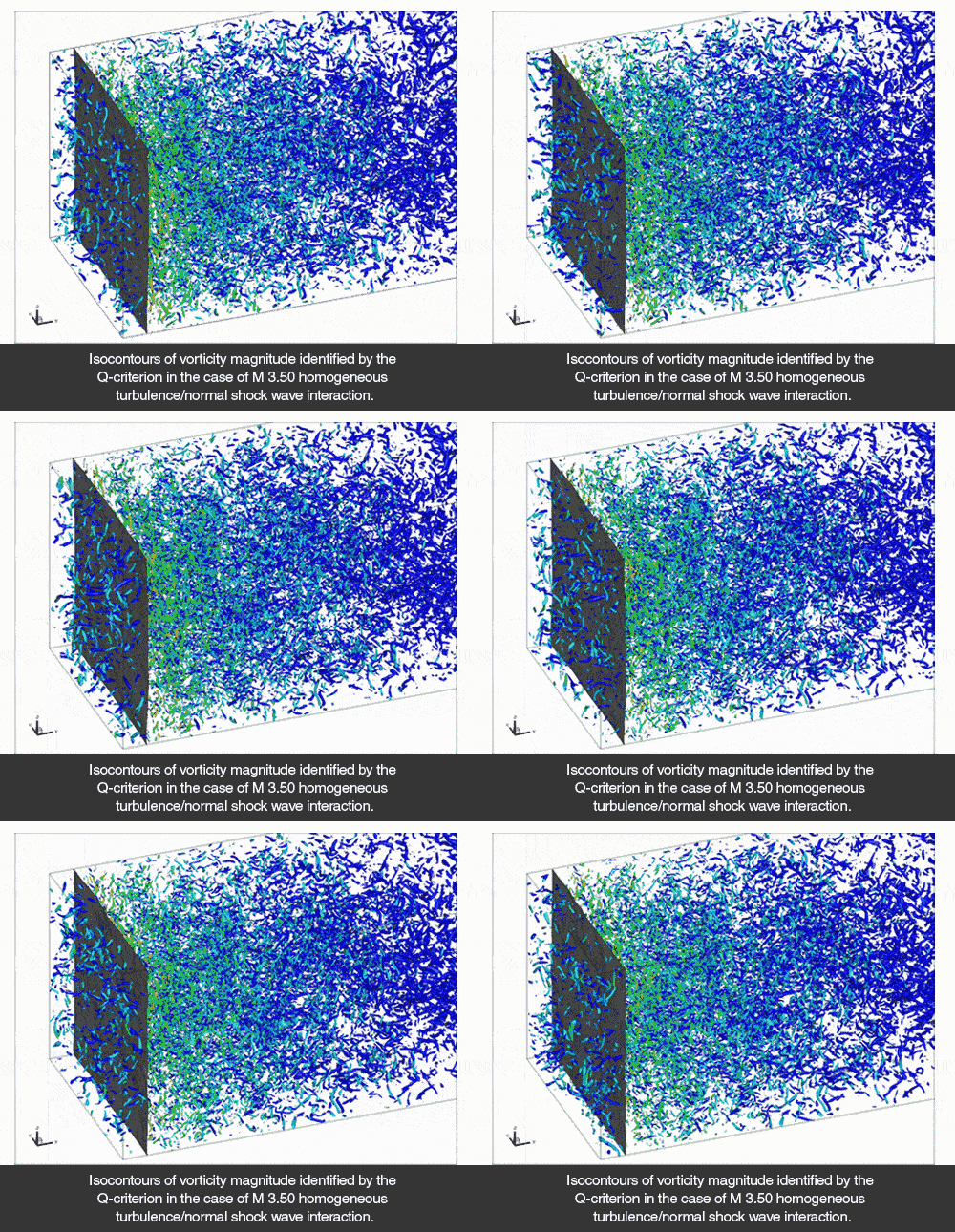
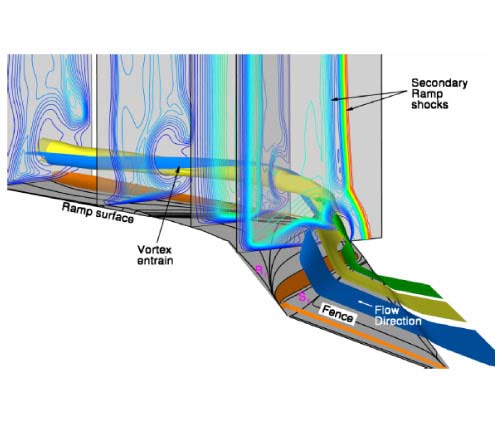
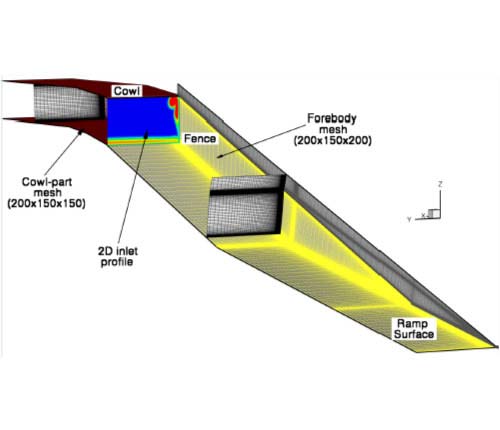
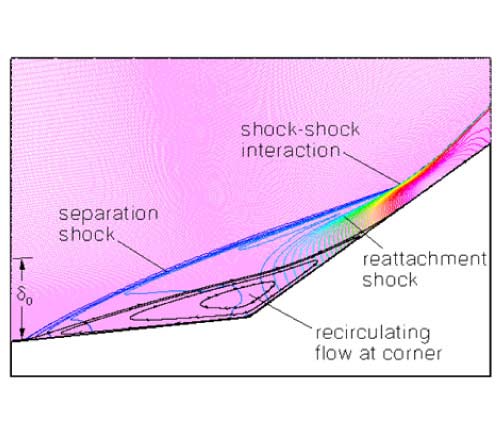
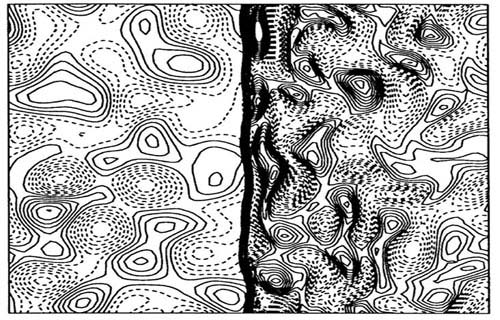
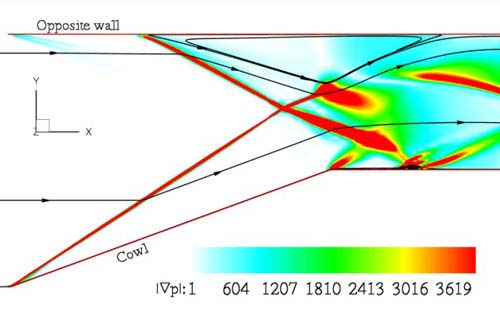
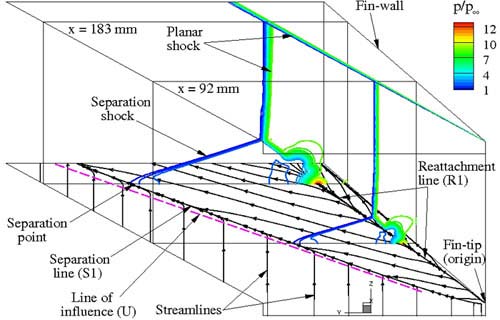
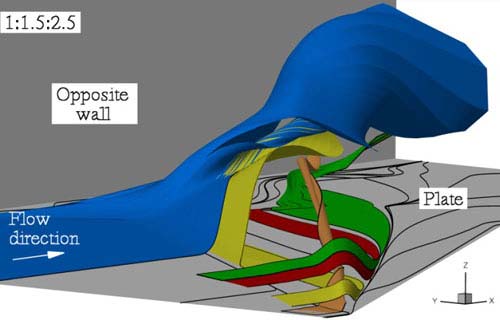
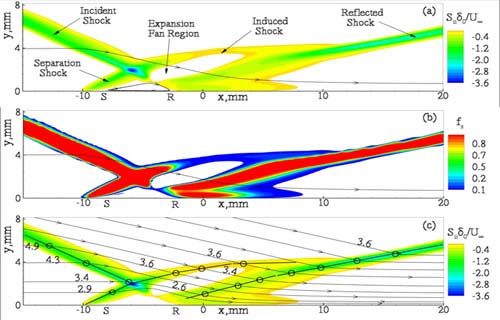
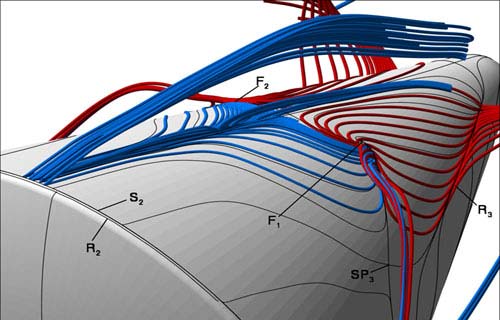
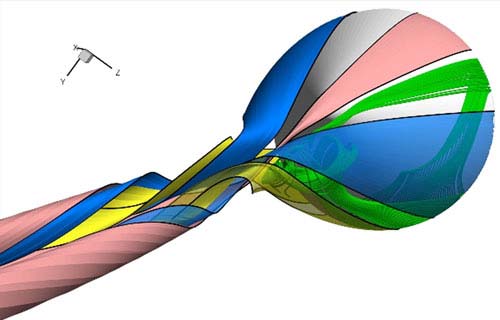
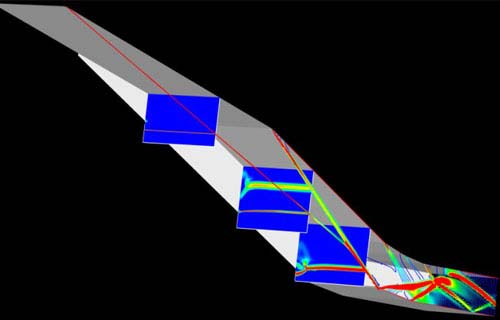
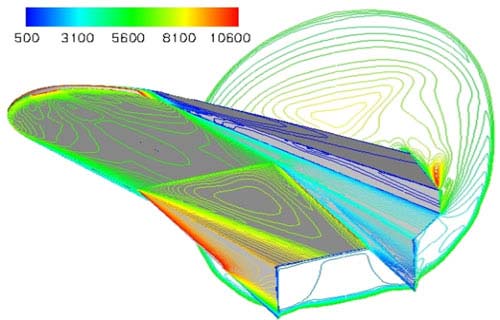
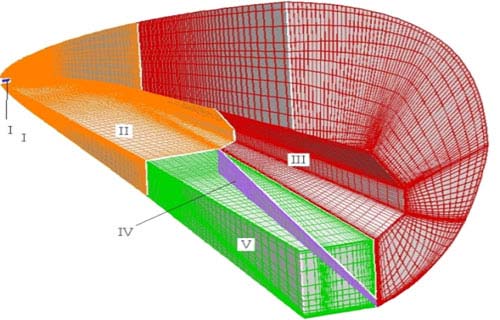
The theme of our research is Analysis, modeling and simulation of high-speed turbulent flows, and we spend a lot of time studying flow physics and doing theoretical analysis. Consider, for example, the interaction of turbulence with a shock wave (shown in inset 'a' in the figure below). We develop new models to capture some of the essential physics without computing all the details of the small scales of turbulence. We then implement the models in CFD codes and tackle unique numerical issues that are encountered in high-speed flows. We compute flows that are relevant to practical applications, such as, oblique shock impinging on a turbulent boundary layer (inset 'b' in the figure). The CFD results are compared with experimental data and we do extensive validation, before taking up real-life configuration like scramjet intake (inset 'c' in figure). Separation bubble formed by shock impingement in a scramjet intake can lead to dramatic effects like intake unstart. The size of the separation bubble is determined by the level of turbulence, which is precisely what we are studying in our theoretical analysis. Our fundamental research thus feeds directly into our applied work and the applications guide what physics we study.

Hypersonic CFD lab specializes in computational research of high-speed turbulent flows, from fundamental studies to real-life applications. We use a combination of theoretical analysis, numerical codes, predictive models and computational simulations to tackle technologically relevant flow problems. A brief description of the different expertise available at Hypersonic CFD lab is given below. Additional details are available for under the "people" tab.
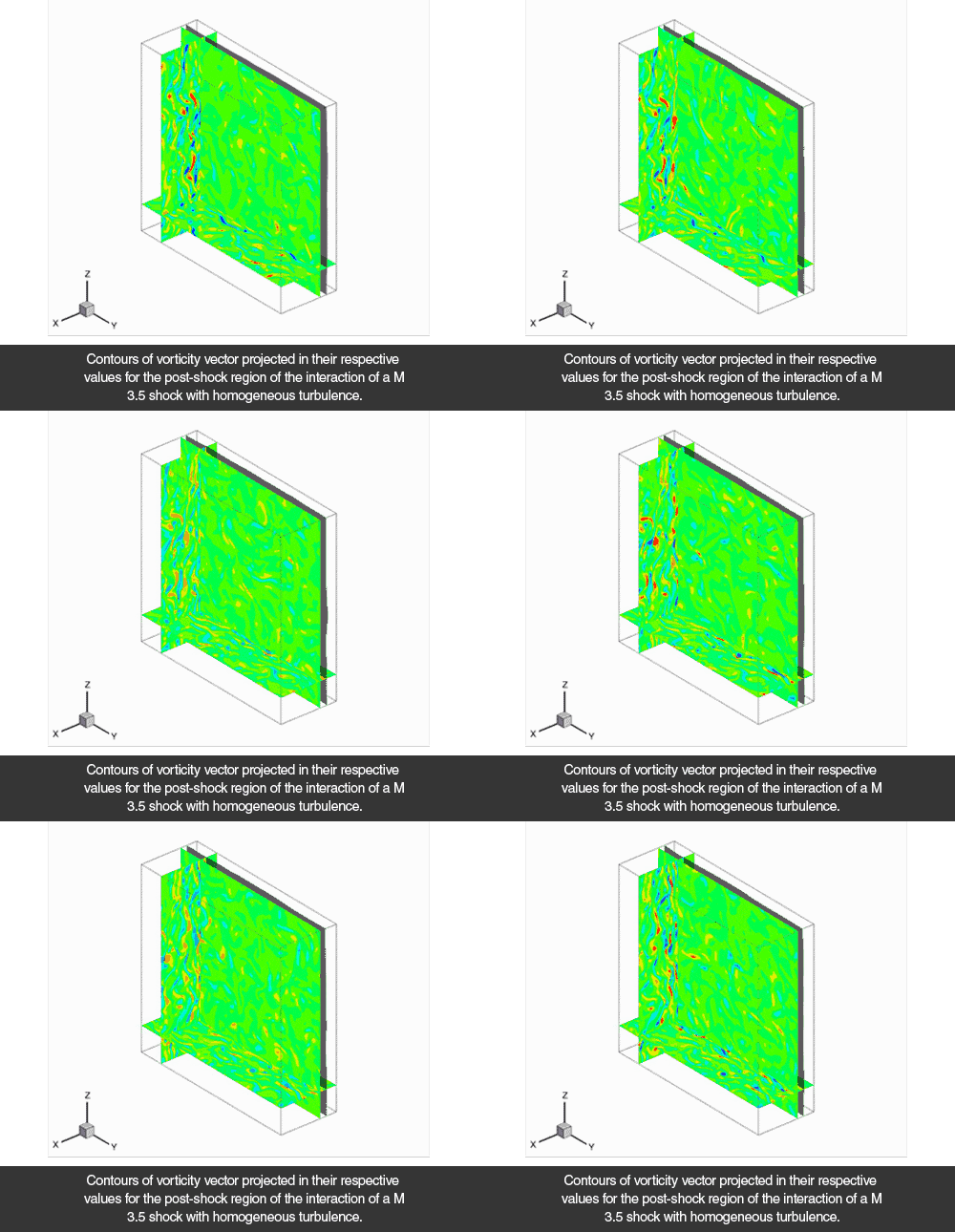
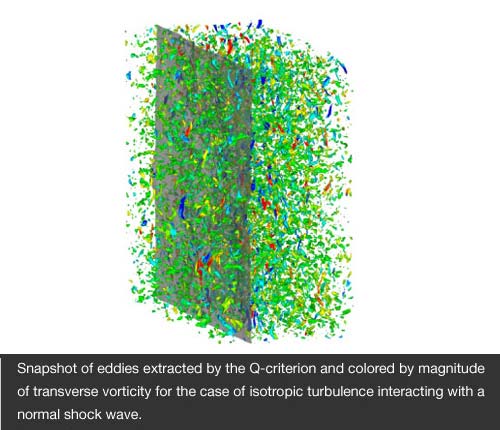
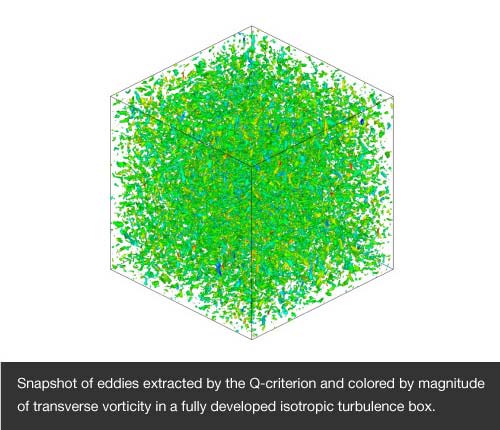
We perform direct numerical simulation of compressible turbulent flows that are dominated by shock waves. We have done extensive calculations of shock-turbulence interaction for a range of Mach numbers and turbulence intensities. The calculations are very expensive in terms of computational resources, with some cases running into 150 million grid points. We also tackle issues related to numerical method to get the best possible result in each case. In a recent paper, we used DNS data to study the high levels of temperature and pressure fluctuations generated by shock waves. Results from this work have implications in a wide range of applications, from high-speed propulsion systems to astrophysical phenomena.
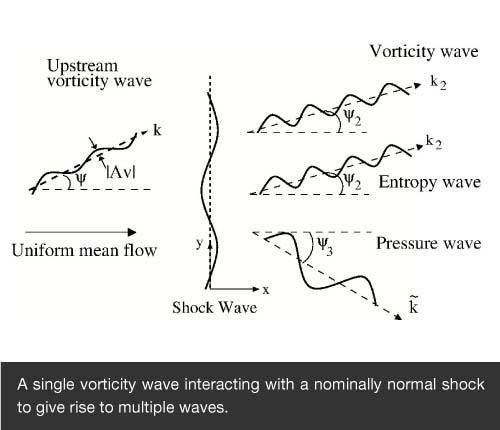
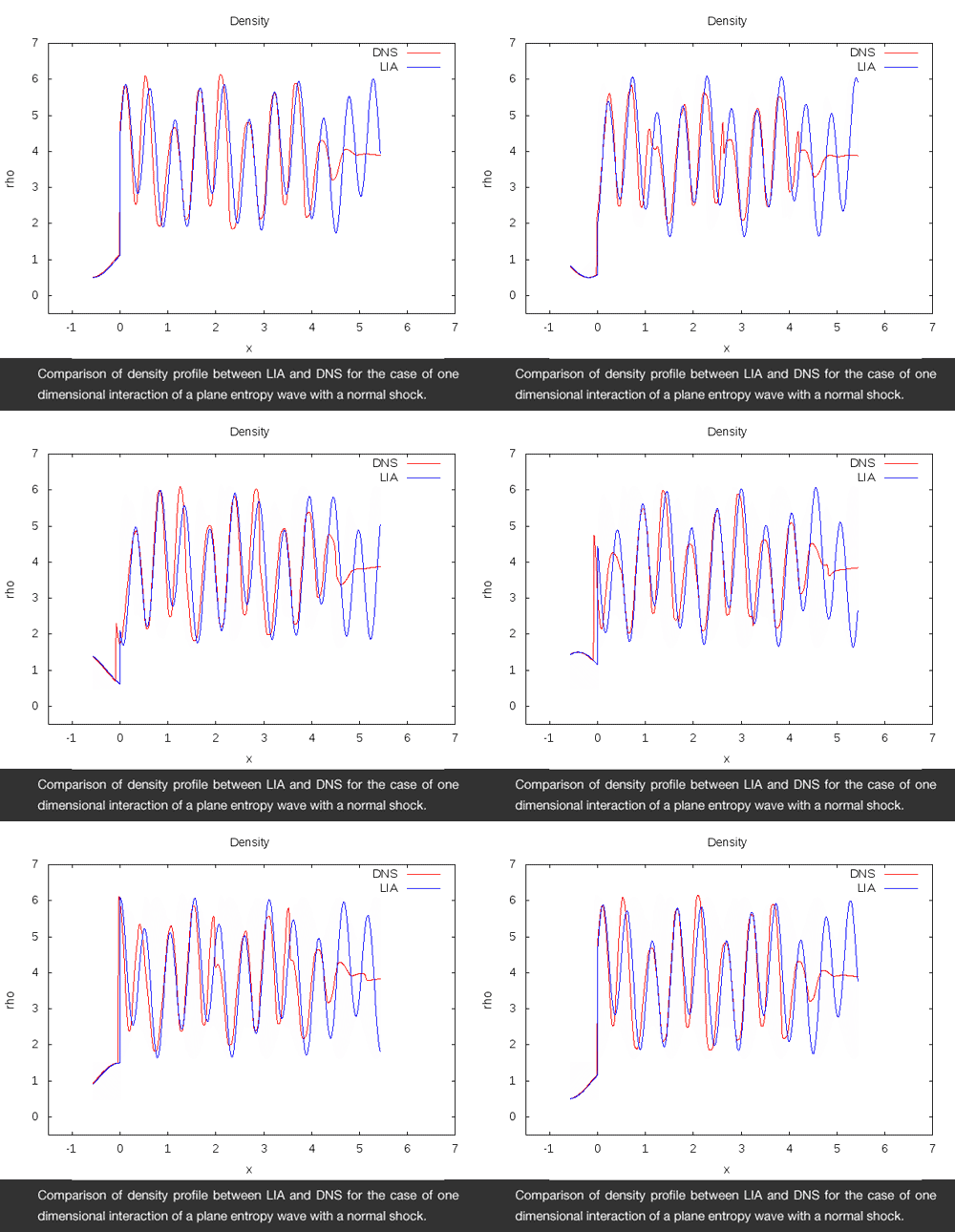
Our work also involves a lot of mathematical analysis. We have been using linear interaction analysis (LIA) -- a theoretical tool based on Kovasznay's classical work on vorticity, entropy and acoustic components of compressible turbulence. LIA was developed in the 1950s and is still used extensively by researchers across the world to study shock-turbulence interaction and related problems. We are tackling fundamental questions about the accuracy of LIA, by comparing the predictions of the theory with carefully designed numerical simulations. Quantifying the bounds of LIA in terms of Mach number etc. is still an open question, and it is especially important in the present context where LIA is being proposed as a surrogate to DNS at shock waves.
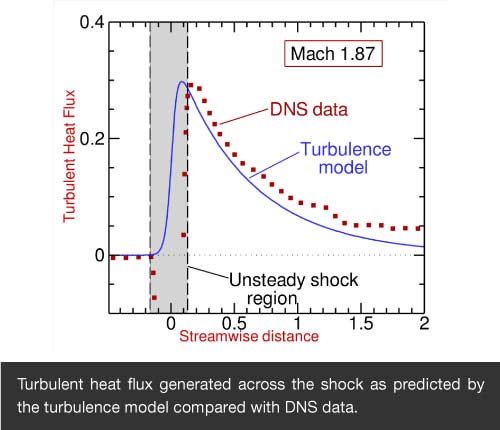
Going from fundamentals to applied research, we are developing predictive models to be used in CFD simulations of high-speed turbulent flows. The aim is to have advanced capability to predict the heat and pressure loads due to shock-boundary layer interaction. By studying the physics of turbulent fluctuations going through a normal shock, we have developed turbulence models for the heat flux generated by shock waves. The model is highly successful in predicting the peak heat transfer in regions of shock impingement and on deflected control surfaces. Accurate prediction of the peak heat transfer is a crucial input to the design of the thermal protection system used in hypersonic flight.
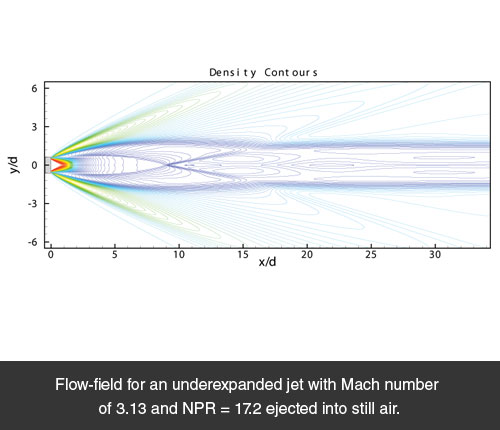
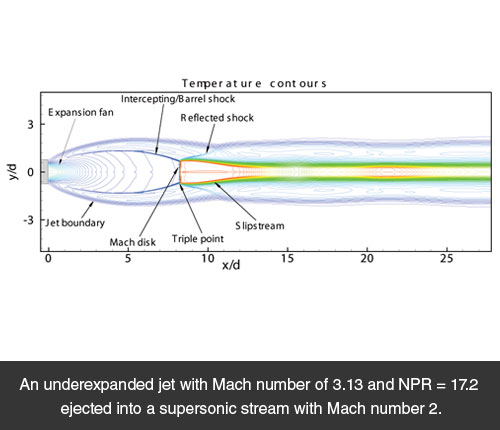
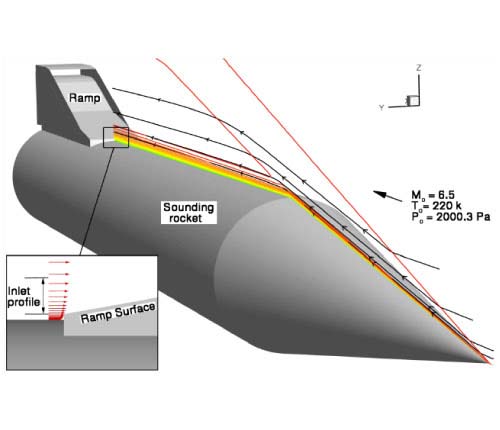
We are also into practical applications of turbulence models in high-speed flows. The main focus is on flows with shock waves and their effect on the aerothermal loads on vehicles. Efficient, robust and accurate turbulence models are key to get good predictions in high Reynolds number flows. We have developed physical models for turbulence amplification by shock waves that are numerically robust and easy to implement in existing CFD codes. The models are particularly suited for 3D simulation of complex configurations. We are tackling flow problems in rocket propulsion, involving multiple jet exhausts in high-lift launch vehicles. The interaction of under-expanded jets from adjacent nozzles can result in high pressure and heat transfer at the base, which in turn, has important implications for the overall vehicle.
We have developed expertise in Reynolds stress modeling in high-speed turbulent flows. These models are ideally suited for capturing the anisotropy (directional dependence) of the turbulent velocity fluctuations. We have been looking into the Reynolds stress anisotropy generated by shock waves, and how it can be predicted by Reynolds stress models. There are elaborate equations in Reynolds stress transport models, as well as numerically efficient algebraic Reynolds stress models, for low speed flows. We are advancing these models to include shock physics and testing them against DNS data of flows with shock waves. The idea is to apply these advanced turbulence models to complex 3D flows in scramjet application.
Taking CFD forward to the design and analysis of real systems is the final goal. This requires extensive testing of the CFD methods and models over the relevant range of Mach and Reynolds numbers. We have shown that the turbulence models developed using DNS and inviscid theory can be successfully applied at realistic Reynolds numbers. The models are then used to predict the aerothermal loads in hypersonic intakes. Practically relevant flight altitude, angle of attack and speed ranges are simulated, at varying wall temperatures. Both design point and off-design conditions are explored and worst case scenarios are identified.
The figure below shows how different aspects of our research and teaching activities come together towards a hypersonic vehicle based on scramjet propulsion. This is a major thrust area under the proposed Center of Propulsion Technology, where we are aiming at a CFD centric approach to integrate computational expertise of different research groups into a single CFD platform. Experimental data will be used to validate and enhance the code, and make it capable to predict at realistic flight conditions.

- Ventilation study in enclosed spaces
- Multi-jet Nozzle Interaction
- Shock-Boundary Layer Interaction
- Scramjet intake simulation
- Stability of hypersonic flows
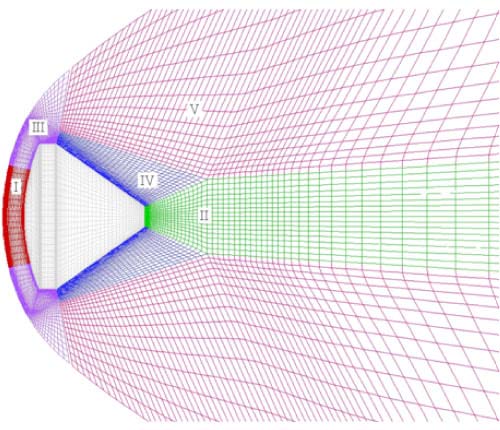
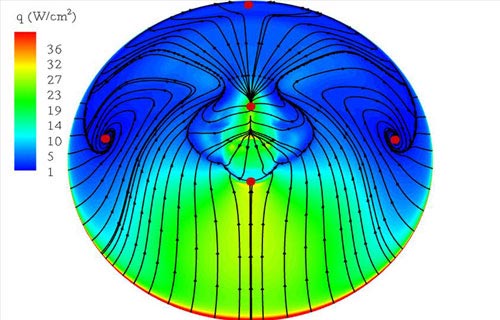
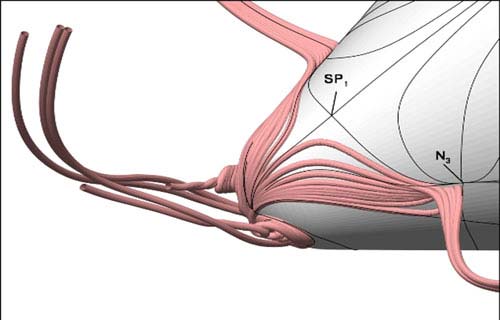
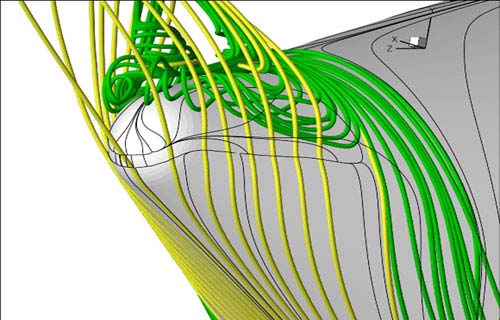
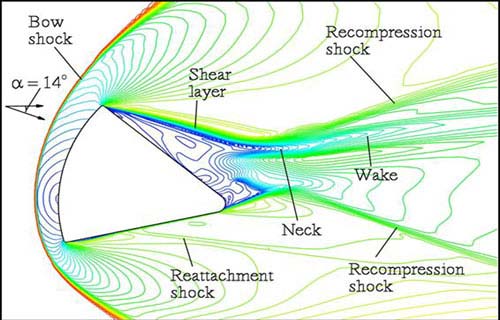
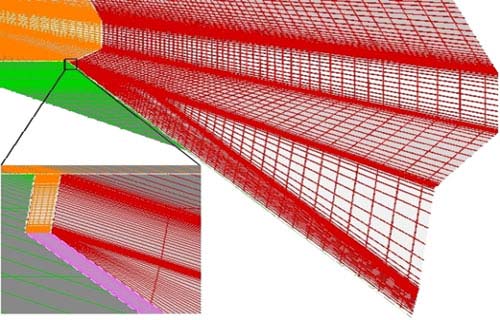
- Re-entry flow simulation
- Shock-turbulence interaction
Old Projects
| Copyright Details | |
| 2021 | |
| Harsha Rathi and Krishnendu Sinha. “Numerical Detection of Shock Location and Shock Strength in Unsteady Flow Computations”. In:AIAA AVIATION 2021 FORUM. Doi: https://doi.org/10.2514/6.2021-2867. | Download PDFAbstract |
| Jagadish B. Vemula, Tanisha Kishor Joshi, and Krishnendu Sinha. “Application of shock-unsteadiness model to interaction of transverse sonic jet and supersonic cross-flow”. In:AIAA AVIATION 2021 FORUM. doi: https://doi.org/10.2514/6.2021-2833 | Download PDFAbstract |
| Raje, Pratikkumar and Sinha, K. “Formulation of advanced SST turbulence model for shock-boundary layer interaction”. In:AIAA AVIATION 2021 FORUM. Doi: https://doi.org/10.2514/6.2021-2841. | Download PDFAbstract |
| Raje, Pratikkumar and Sinha, K. “Anisotropic SST turbulence model for shock-boundary layer interaction”. Computers & Fluids, Vol. 228, p.105072, October, 2021. Doi: https://doi.org/10.1016/j.compfluid.2021.105072 | Download PDFAbstract |
| Krishnendu Sinha, Mani Shankar Yadav, Utkarsh Verma, Janani Srree Murallidharan and Vivek Kumar “Effect of recirculation zones on the ventilation of a public washroom”. , Physics of Fluids 33, 117101 (2021); DOI: https://doi.org/10.1063/5.0064337 | Download PDFAbstract |
| 2020 | |
| Pranav Thakare, Krishnendu Sinha, Vineeth Nair. "Second Order Analysis for Shock Vorticity Wave Interaction", at 6th National symposium on Shock waves-IITM (NSSW-2020). | Download PDFAbstract |
| Sethuraman, Y.P.M. and Sinha, K. "Modeling of thermodynamic fluctuations in canonical shock-turbulence interaction", AIAA Journal, Vol. 58, No. 7 (July 2020), pp. 3076-3089 doi:doi/abs/10.2514/1.J059124 | Download PDFAbstract |
| 2019 | |
| Sethuraman, Y.P.M. and Sinha, K. "Effect of turbulent Mach number on the thermodynamic fluctuations in canonical shock-turbulence interaction". Computers & Fluids, Vol. 197, p.104354, October, 2019 | Download PDFAbstract |
| Jagadish Babu Vemula and Krishnendu Sinha, "Explicit algebraic Reynolds stress model to predict anisotropy in shock-turbulence interaction.", 32nd International Symposium on Shock Waves (ISSW32), 14 – 19 July 2019, Singapore. | Download PDFAbstract |
| Pranav Thakare, Yogesh Prasaad, Krishnendu Sinha, and Vineeth Nair "Comparative study of linear interaction analysis and DNS for shock vorticity interaction: Scaling of non-linear terms.", 32nd International Symposium on Shock Waves (ISSW32), 14 – 19 July 2019, Singapore. | Download PDFAbstract |
| Subhajit Roy, Krishnendu Sinha, Francis Lacombe, and Jean-Pierre Hickey, "Anisotropic turbulent heat flux modelling through shock waves," AIAA Aviation and Aeronautics Forum and Exposition, June, 2019. | Download PDFAbstract |
| Praktikkumar Raje and Krishnendu Sinha, "Three-dimensional simulation of rocket nozzles with multi-jet interaction using shock-unsteadiness model," AIAA Aviation and Aeronautics Forum and Exposition, June, 2019. | Download PDFAbstract |
| Rachit Singh and Krishnendu Sinha, "Shock Induced Flow-Separation in Hypersonic Intakes at Off-design Conditions," Journal of Aerospace Sciences and Technologies, Vol.71, No.2, pp.231-249, 2019. | Download PDFAbstract |
| Subhajit Roy and Krishnendu Sinha, "Turbulent Heat Flux Model for Hypersonic Shock-Boundary Layer Interaction," AIAA Journal, 2019. | Download PDFAbstract |
| Sinha, K. and Yogesh Prasaad, M. S., "Analysis and modeling of thermodynamic fluctuations generated by shock-turbulence interaction", AIAA 2019 SciTech Forum, AIAA Paper 2019-2155, 2019. | Download PDFAbstract |
| Subhajit Roy, Bijaylakshmi Saikia, and Krishnendu Sinha, "Heat transfer prediction in shock-turbulent boundary layer interaction at flight enthalpy" AIAA 2019 SciTech Forum, AIAA Paper 2019-2155, 2019. | Download PDFAbstract |
| 2018 | |
| Rachit Singh and Krishnendu Sinha, "Parametric study of factors affecting shock-induced flow separation in scramjet intakes," 20th Annual CFD Symposium, August 09-10, 2018, CSIR - National Aerospace Laboratories, Bangalore, India. | Download PDFAbstract |
| Sethuraman, Y. P. M., Sinha, K., and Larsson, J., "Thermodynamic Fluctuations in canonical shock-turbulence interaction: effect of shock strength." Theoretical and Computational Fluid Dynamics , 32(5), 629--654, 2018 | Download PDFAbstract |
| Roy, S., and Sinha, K., "Variable turbulent Prandtl number model applied to hypersonic shock/boundary-layer interactions" 48th AIAA Fluid Dynamics conference, Atlanta United States of America, 25 - 29 June 2018. | Download PDFAbstract |
| Pathak, U., Roy, S., and Sinha, K., A phenomenological model for turbulent heat flux in high-speed flows with shock-induced flow separation," Journal of Fluid Engineering, Vol. 140, No. 5, pp. 1-9, 2018. | Download PDFAbstract | Roy, S., Pathak, U., and Sinha, K., "Variable turbulent Prandtl number model for shock/boundary-layer interaction" AIAA Journal, Volume 56, Issue 1, pp. 342-355, 2018. | Download PDFAbstract |
| 2017 | |
| Madras Sethuraman, Y. P., Sinha, K., and Larrson, J., "Thermodynamic fluctuations in canonical shock-turbulence interaction", Tenth International Symposium on Turbulence and Shear Flow Phenomena (TSFP10), Chicago, Illinois, United States of America, 6 – 9 July 2017. | Download PDFAbstract |
| Vemula, J. B. and Sinha, K., "Reynolds stress models applied to canonical shock-turbulence interaction", Journal of Turbulence, Volume 19, Issue 7, pp. 653-687, April 2017. | Download PDFAbstract |
| Vemula, J. B., Pathak, U. and Sinha, K., "Comparative Analysis Of Ramp-type And Busemann Intakes For Hypersonic Air-breathing Engine" Proceedings of 1st National Aerospace Propulsion Conference NAPC-2017, IIT Kanpur, March 15-17, 2017. | Download PDFAbstract |
| Raje, P., Saikia, B. and Sinha, K., "Numerical investigation of axisymmetric underexpanded supersonic jets" Proceedings of 1st National Aerospace Propulsion Conference NAPC-2017, IIT Kanpur, March 15-17, 2017. | Download PDFAbstract |
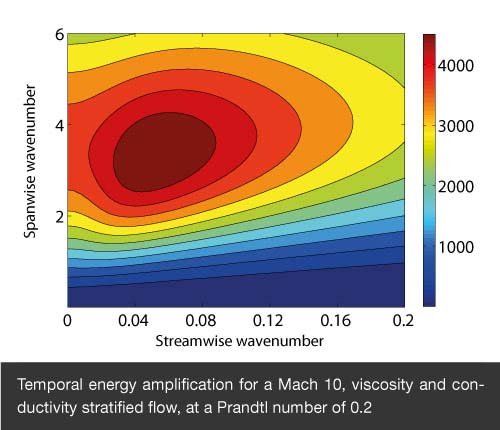
| Saikia, B., Ramachandran, A., Sinha, K. and Govindarajan, R., "Effects of viscosity and conductivity stratification on the linear stability and transient growth of compressible Couette flow", Physics of Fluids, Volume 29, Issue 2, 024105, January 2017. | Download PDFAbstract |
| 2016 | |
| Vemula, J. B., Raje, P., Singh, R., Roy, S. and Sinha K., 10-11 August 2016, "Parametric study of the performance of two-dimensional Scramjet Intake", 18th Annual AeSI CFD Symposium, CSIR-National Aerospace Laboratories, Bangalore, India. (http://www.nal.res.in/cfdsympo) | Download PDFAbstract |
| Quadros, R. and Sinha, K., "Modelling of turbulent energy flux in canonical shock-turbulence interaction", International Journal of Heat and Fluid Flow, Volume 61, Part B, pp. 626-635, October 2016. | Download PDFAbstract |
| Ramachandran, A., Saikia, B., Sinha, K. and Govindarajan, R., "Effect of Prandtl number on the linear stability of compressible Couette flow", International Journal of Heat and Fluid Flow, Volume 61, Part B, M pp. 553-561, October 2016. | Download PDFAbstract |
| Sinha, K. and Singh, R. "Numerical Error in the k-ε Turbulence Model applied to Eddyviscous Shock Waves", AIAA Journal, Volume 54, Issue 11, pp. 3676-3681, November | Download PDF |
| Raje, P. and Sinha, K. "A physically consistent and numerically robust k-ε model for computing turbulent flows with shock waves", Computers & Fluids, Volume 136, pp. 35-47, September 2016. | Download PDFAbstract |
| Quadros, R., Sinha, K. and Larsson, J. "Turbulent energy flux generated by shock/homogeneous-turbulence interaction", Journal of Fluid Mechanics, Volume 976, pp. 113-157, June 2016. | Download PDFAbstract |
| Quadros, R., Sinha, K. and Larsson, J. "Kovasznay Mode Decomposition of Velocity Temperature Correlation in Canonical Shock-Turbulence Interaction", Flow, Turbulence and Combustion, Volume 97, Issue 3, pp. 787-810, October 2016. | Download PDF Abstract |
| 2015 | |
| K. Sinha, A. Ramachandran, B. Saikia, and R. Govindarajan, "Effect of Prandtl Number on the Stability of Compressible Couette flow"., American Physical Society Division of Fluid Dynamics, Boston, MA, United States of America, 21st & 23rd November 2015. | Download PDF Abstract |
| Quadros, R., and Sinha, K., "Modeling of Turbulent Energy Flux in Canonical Shock- Turbulence Interaction", Ninth International Symposium on Turbulence and Shear Flow Phenomena TSFP-9, Melbourne, Australia, June 30-July 3, 2015. | Download PDFAbstract |
| Vemula, J. B. and Sinha, K., "Reynolds Stress Models Applied to Shock-Turbulence Interaction" Ninth International Symposium on Turbulence and Shear Flow Phenomena TSFP-9, Melbourne, Australia, June 30-July 3, 2015. | Download PDFAbstract |
| Ramachandran, A. , Saikia , B. , Sinha, K. and Govindarajan, R. , "Linear stability of high-speed boundary layer flows at varying Prandtl numbers", 45th AIAA Thermophysics Conference, AIAA 2015-2320, Dallas, Texas, United States of America, 22 - 26 June 2015. | Download PDFAbstract |
| 2014 | |
| Reddy, D.S.K., Saikia, B., and Sinha, K., "Effect of high-enthalpy air chemistry on stagnation point heat flux", Journal of Thermophysics and Heat Transfer, Volume 28, Issue 2, pp. 356-359, April-June 2014. | Download PDFAbstract |
| Sashittal, P. A., Madras Sethuraman, Y. P., Larsson, J. and Sinha, K., "Study of unsteady shock motion in shock/turbulence interaction",7th AIAA Theoretical Fluid Mechanics Conference, AIAA 2014-3341, Atlanta, Georgia, United States of America, 16 - 20 June 2014. | Download PDFAbstract |
| 2013 | |
| Quadros, R. and Sinha, K., "Physics Based Modeling of Turbulent Heat Flux in Shock Dominated Flows.", 2nd SFB-TR 40 Summer Program Research Briefs, Garching, Munich, Germany, July 2013. | Download PDFAbstract |
| K. Sinha and S. J. Balasridhar, "Conservative Formulation of the kϵ Turbulence Model for Shock–Turbulence Interaction" AIAA Journal, Volume 51, Issue 8, pp. 1872-1882, August 2013. | Download PDFAbstract |
| Quadros, R., Sashittal, P. A., Ramachandran, A. and Sinha, K., "Evolution of turbulent heat flux across a shock wave" The 5th European Conference for Aeronautics and Space Sciences, Munich, Germany 1-5 July 2013 | Download PDFAbstract |
| Sinha,K. , and Balasridhar, S. J., "A conservative turbulence model for shock dominated flows" The 5th European Conference for Aeronautics and Space Sciences, Munich, Germany 1-5 July 2013 | Download PDFAbstract |
| 2012 | |
| Sinha, K., "Evolution of enstrophy in shock/homogeneous turbulence interaction", Journal of Fluid Mechanics, Volume 707, pp. 74-110, September 2012. | Download PDFAbstract |
| Reddy, D. S. K. and Sinha, K., "Analysis of High-Enthalpy Air Chemistry and its Effect on Stagnation Point Heat Flux", 43rd AIAA Thermophysics Conference, AIAA 2012-3002 , New Orleans, Louisiana, United States of America, 25-28 June 2012. | Download PDFAbstract |
| Pasha, A. A. and Sinha, K., "Simulation of Hypersonic Shock/Turbulent Boundary Layer Interactions Using Shock-Unsteadiness Model", Journal of Propulsion and Power, Volume 28, Issue 1, pp. 46-60, January-February 2012. | Download PDFAbstract |
| 2011 | |
| Sarvesh, S., Nithiyaraj, M., Pawar, V., and Sinha, K., "Effect of Side-fence on Shock/Boundary Layer Interaction in a Scramjet Inlet," Symposium on Applied Aerodynamics and Design of Aerospace Vehicles, Bangalore, India, November 2011. | Download PDFAbstract |
| Pasha A.A., Vadivelan C. and Sinha K., "Simulation of a Practical Scramjet Inlet Using Shock-Unsteadiness Model." 28th International Symposium on Shock Waves, Springer, pp 477- 482, Berlin, Heidelberg, Germany, 17-22 July 2011. | Download PDFAbstract |
| Sinha, K., Rane, N., J. and Pawar, V., "Numerical Investigation of three Dimensional shock/boundary-layer interaction in a hypersonic inlet", 28th International Symposium on Shock Waves, The University of Manchester, United Kingdom, 17-22 July 2011. | Download PDFAbstract |
| Reddy, D. S. K., and Sinha, K., "Effect of Chemical Reaction Rates on High-enthalpy Flow Prediction Around a Re-entry Capsule", Journal of Thermophysics and Heat Transfer, Volume 25, Issue 11, pp. 21-33, June 2011. | |
| Reddy, D. S. K., and Sinha, K., "Effect of Chemical Reaction Rates on High-enthalpy Flow Prediction Around a Re-entry Capsule", Journal of Thermophysics and Heat Transfer, June 2011. | Download PDFAbstract |
| 2010 | |
| Sinha, K., "Computational Fluid Dynamics in Hypersonic Aerothermodynamics",. Defense Science Journal, Volume 60, Issue 6, pp. 663-671, November 2010. | |
| Rane, N., Pawar, V. and Sinha, K., "Effect of geometric variations on three-dimensional flow separation in a practical scramjet inlet", 12th Annual AeSI CFD Symposium, Indian Institute of Science, Bangalore, India, 11-12 August 2010. | Download PDFAbstract |
| Pasha, A. A. and Sinha, K., "Simulation of hypersonic shock/turbulent boundary-layer interactions using advanced turbulence models", The 8th Asian Computational Fluid Dynamics Conference, Hong Kong, China, 10-14 January 2010. | |
| Dey, A. and Sinha, K., "Simulation of Flow Separation and Reattachment on a Re-Entry Capsule Afterbody Frustum", 48th AIAA Aerospace Sciences Meeting Including the New Horizons Forum and Aerospace Exposition, AIAA 2010-1561, Orlando, Florida, United States of America, 4-7 January 2010. | Download PDFAbstract |
| 2009 | |
| Reddy, D.S.K. and Sinha, K., "Effect of Transport Coefficients on Aero-thermal Predictions of Re-entry Flows", Fourth Symposium on Applied Aerodynamics and Design of Aerospace Vehicles, Bangalore, India, December 2009. | Download PDFAbstract |
| Pawar, V., Rane, N. and Sinha, K., "Three-dimensional Shock/Turbulent Boundary Layer Interaction in a Simulated Scramjet Inlet", Fourth Symposium on Applied Aerodynamics and Design of Aerospace Vehicles, Bangalore, India, December 2009. | Download PDFAbstract |
| Sinha, K. and Pawar, V., "Shock/turbulence interaction: turbulence modeling and scramjet application", 11th Annual AeSI CFD Symposium 2009, Indian Institute of Science, Bangalore, India, 11-12 August 2009. | Download PDFAbstract |
| Pasha, A. A. and Sinha, K., "Simulation of threedimensional shock/boundary-layer interaction in a single-fin configuration", 11th Annual AeSI CFD Symposium 2009, Indian Institute of Science, Bangalore, India, 11-12 August 2009. | Download PDFAbstract |
| Reddy, D. S. K. and Sinha, K., "Hypersonic Turbulent Flow Simulation of Fire II Re-entry Vehicle Afterbody", Journal of Spacecrafts and Rockets, Volume 46, Issue 4, pp. 745-757, July 2009. | Download PDFAbstract |
| Veera, V. K. and Sinha, K., "Modeling the effect of upstream temperature fluctuations on shock/homogeneous turbulence interaction", Physics of Fluids, Volume 21, Issue 2, 025101, February 2009. | Download PDFAbstract |
| 2008 | |
| Pasha, A. A. and Sinha, K., "Shock-unsteadiness model applied to oblique shock wave/turbulent boundary-layer interaction", International Journal of Computational Fluid Dynamics, Volume 22, Issue 8, pp. 569-582, September 2008. | Download PDFAbstract |
| Sinha, K. and Vadivelan, C., "Effect of Angle of Attack on Reentry Capsule Afterbody Flowfield", 48th AIAA Aerospace Sciences Meeting and Exhibit, AIAA 2008-1282, Reno, Nevada, 7-10 January 2008. | Download PDFAbstract |
| 2007 | |
| Pasha, A. A. and Sinha, K. "Shock Unsteadiness Modification Applied to Oblique Shock Wave/Turbulent Boundary-Layer Interaction", 34th Fluid Mechanics Fluid Power Conference, Birla Institute of Technology and Science, Ranchi, India, December 2007. | Download PDFAbstract |
| Reddy, D. S. K. and Sinha, K., "Analysis of Non-equilibrium Thermo-chemistry in Fire II Reentry Flowfield", 34th Fluid Mechanics Fluid Power Conference, Birla Institute of Technology and Science, Ranchi, India, December 2007. | Download PDFAbstract |
| Sinha, K. and Reddy, D.S.K., "Hypersonic Turbulent Reacting Flow Simulation of Fire II Reentry Vehicle", 45th AIAA Aerospace Sciences Meeting and Exhibit, AIAA 2007-805, Reno, Nevada, United States of America, 8-11 January 2007. | Download PDFAbstract |
| Sinha, K., "Effect of Reynolds Number on Detached Eddy Simulation of Hypersonic Base Flow", 45th AIAA Aerospace Sciences Meeting and Exhibit, AIAA 2007-1457, Reno, Nevada, United States of America, 8-11 January 2007. | Download PDFAbstract |
| Sinha, K. and Candler, G.V., "Grid Sensitivity of Detached Eddy Simulation of a Mach 16 Re-Entry Configuration", 45th AIAA Aerospace Sciences Meeting and Exhibit, AIAA 2007-1115, Reno, Nevada, United States of America, 8-11 January 2007. | Download PDFAbstract |
| Sinha, K. and Vadivelan, C., "Reynolds-averaged Navier Stokes simulation of scramjet inlet flowfield", 7th Asian Computational Fluid Dynamics Conference, Bangalore, India, 2007. | Download PDFAbstract |
| 2006 | |
| Kedia, K. S. and Sinha, K., "Effect of Compressibility Corrections to Turbulence Models Applied to a Hypersonic Re-entry Configuration", 33rd National and 3rd International Conference on Fluid Mechanics and Fluid Power, Indian Institute of Technology Bombay, India, 7-9 December 2006. | Download PDFAbstract |
| Sinha, K., "Shock unsteadiness model applied to hypersonic shock-wave/turbulent boundary layer interactions", 44th AIAA Aerospace Sciences Meeting and Exhibit, AIAA 9-12 January 2006, Reno, Nevada, United States of America, | |
| 2005 | |
| Sinha, K., "Reynolds-averaged Navier-Stokes simulation of Fire II re-entry configuration", International Symposium on Shock Waves, 478-483, Indian Institute of Science, Bangalore, India, 17-22 July 2005. | |

- Ventilation studies in classrooms at IIT Bombay using CFD and droplet tracking
- Launch vehicle base heating prediction due to reversed flow and nozzle wall ablation
- Heat flux prediction in shock-boundary layer interaction and multi-jet interaction with reversed flow
- Analysis and modeling of turbulence amplification across a shock wave
- Study of shock turbulent boundary layer interaction in high speed air intake - Phase II
- Assessment of turbulence models in hypersonic reacting three-dimensional flow around re-entry flight vehicles
- Study of Shock Turbulent boundary layer interaction in high speed air intake
- Forebody CFD studies of HSTDV cruise vehicle.