

 |
 |
 |
 |
Internship Experience
Posted By : Sushmitha JanakiramThe lab ecosystem was highly conducive to research. The support in terms of facilities and the intellectual exchange was remarkable with people working on diverse problems.
Experience at ISSW conference, NUS
Posted By : Pranav Thakre | Posted On : Jul 15, 2019I gave a talk at ISSW32 today. It was well received amongst the audience which was primarily from the experimental field. I finished the talk within a given time and had few minor questions which I tried to answer. Overall it was a good experience.
I had a discussion with the well-known researchers within the shockwave community. Then we attended a talk by Prof. Frank Lu from University of Texas at Arlington on the rotary detonation engine, and I had a good interaction with him. After that we attended a talk by Prof. Devesh Ranjan on the RM instability. We had a good discussion with him regarding our work and how our work could be relevant to the work he is doing now. Overall it was a great experience interacting with the researchers from the community and to know about the work going on.
Experience at AIAA conference : Presentation day
Posted By : Pratikkumar Raje | Posted On : Jun 20, 2019.Today were my presentations in the morning session 9.30 - 10 am (Subhajit's ppt) and 10 - 10.30 am (mine). Both the presentations went very well.
I finished Subhajit's presentation in about 20 mins. There were about 10-12 attendees. After the presentation, I asked the audience to ask me any questions which I will try to answer and would convey the same to the authors. Only one question was asked. In the heat flux model for STI, there's this alpha model parameter. The question was if it was tuned for the heat flux model to match the results.
As the presentation with that one question got over in 20 mins, I had 10 mins of break time before my next presentation.
During my 2nd presentation (on my work), there were about 16-17 people. I finished my presentation in about 25 mins. Following questions were asked:
1) what about validation with the experiments for base pressure and heat flux
2) simulation time and machine used for the simulations
3) how do we change SU model back to std k-om model in shock-free regions
I could answer all the questions to the audience's satisfaction.
After the questions in my 2nd presentation (my multi-jet interaction work), there was a NASA guy who shared his experience while building the Saturn V rocket and the problems which NASA faced during that project. He made a remark at the end that if we had done our multi-jet interaction work during the Saturn V time, we would have made billions !!
After my presentations, I attended a full session till evening which was dedicated to NASA's Space Launch System (SLS). The presentations were given by NASA guys who are working in the project to develop the SLS.
Overall, it was a good day.
Experience at AIAA conference : First day
Posted By : Pratikkumar Raje | Posted On : Jun 18, 2019.Today was the first day of the AIAA conference. I reached at the conference venue (Hilton Anatole hotel) at around 10 am and after doing registration (getting ID and a book of presentation schedule), I attended 2 talks by NASA guys from 10.30 to 11.30 am. They were based on transonic experiments similar to Bachalo-Johnson's transonic bump classic experiment with a goal to generate data sets with all the details such as boundary conditions and geometry specifications required for turbulence modeling validation. The morning session presentation ended at 11.30 am today.
Then in the afternoon, I attended a single session "Progress towards CFD vision 2030 " from 2 - 5.30 pm. All the talks were interesting in that NASA's goal to improve different aspects of CFD, like turbulence modelling, grid generation, numerical solvers, computing methods, etc. were the topics of the talk. The talks were given by NASA, Boeing, Pointwise (Gridgen) and other industry guys. The session ended with Spalart's (from the SA model) talk (related to how RANS, DES and DDES predicts spurious eddy-viscosity values in regions where the turbulence models should predict negligible values).
One important point which was mentioned again and again in all of these talks was :
A survey was conducted asking different CFD related questions to industry, academia, and NASA experts. One of the questions was: which is the one area in CFD that showed little to no improvement over the years : Interestingly the answer was prediction of laminar/turbulent separation (including SBLI separation). Prediction of shock/boundary layer interaction is still viewed as one of the problems far from being solved. These survey questions were mentioned by all the presenters during this session.
AIAA conference feedback
Posted By : Subhajit Roy, Ph.D. student | Posted On : Jun 28, 2018Today I explain my work to Michael Holden and Matthew MacLean of NASA. They are impressed by our model and asked me to forward our paper to their official email address. They also asked me, they have some data on cavity and scramjet, if we can use those data to validate our model further. As per there knowledge, no one has achieved such good heat flux measurements from computation as our.
AIAA conference presentation
Posted By : Subhajit Roy, Ph.D. student | Posted On : Jun 28, 2018My presentation went very well and I took 25 minutes to finish the talk. There were only 2 questions about how we are calculating b1 and r in the flow field and whether we need any experimental data or not to calculate those term. I had an after talk discussion with Michelle, colleague of T.J. Coakley, and the session chair. They are impressed with the model. Michael told that he will give a copy of our paper to Coakley and he wants us to compute some more cases done by Coakley. He also told that many authors are trying to improve this problem but we are really lucky that we got such an impressive results. I gave your aero email id to him, so he may contact you. Santanu ghosh was also there in my talk but I could not interact with him as he left immediately after talk. Feedback
Feedback on scramjet work
Posted By : Vijeth Hebbar, Undergraduate Student | Posted On : Jan 22, 2018,I had an enriching experience working in the area of scramjets at the Hypersonic CFD lab over a duration of 6 months. I started the project in my winter break after my third semester and continued it for another semester. Having completed a basic course in the thermodynamics as well as fluid mechanics I had a great opportunity to see the practical aspects of these courses during my work on the project. Of course, I did have to undergo a steep learning experience as I had to familiarise myself with compressible flows for the study in scramjets. An online course along with support from the senior researchers at the lab helped me in the initial stages of my work. The problem statement given to us was really intriguing in itself. We were charged with doing a design point thermodynamic analysis for a certain scram-jet geometry. Subsequently, we also attempted to analyse the scramjet performance at off-design point conditions. While, my research interests have since deviated away from this area, I did really enjoy exploring the field of hypersonics. Prof. Sinha is an excellent teacher and a great guide and working under him was, overall, an amazing learning experience
Scramjet Project Experience (Internship)
Posted By : Tanisha Joshi | Posted On : November 8, 2017I spent a wonderful summer working on the project on scramjets. Its a fascinating and a comparatively nascent field in aerospace, and I enjoyed exploring it. I learnt about shockwaves, the hypersonic combustion process and many more aspects of a scramjet. There was plenty of mathematics and programming involved too and I loved it! I was free to explore and work on whatever piques my interest and Sinha Sir was a great guide throughout.
Experience at CFD lab
Posted By : Utkarsh Pathak | Posted On : October 12, 2017I write my experience at the Hypersonic CFD lab from the perspective of a masters student. I have spent more than 2 years working in the lab, first as a masters student pursuing his thesis, and then as a research assistant working on a project funded by ISRO. I began the M.Tech program at IIT Bombay after working in the manufacturing industry for more than 3 years, and had a limited experience in scientific research prior to it. Joining the Hypersonic CFD lab helped me imbibe the methodology utilized for scientific research. I was encouraged to devote a lot of time to literature survey, to ensure that my proposals for further action are based on solid reasoning. Regular discussions with Prof. Sinha kept me on track and prevented me from losing the big picture among details. Getting acquainted with the research carried out at the lab helped me understand the importance of knowing the physics of a problem before moving on to flow simulations. Frequent presentations by other students in the lab also fostered a better understanding of physics for various flows. Based on my understanding of the problem (heat flux prediction in SBLI flows), I aimed to develop a mathematical model for high-speed turbulent flows with SBLI. I was given the freedom to pursue my own ideas, and conversations with Prof. Sinha helped me weed out the faulty ones from those that were justified. Working with the in-house code to test my mathematical models was crucial and it made me realize the importance of programming in CFD. I was inspired to write my own codes and by the end of my tenure at the lab, I was able to write a 2D unstructured mesh RANS code of my own. My technical writing ability, though not as good as I would like it to be, has improved greatly because of my work on the thesis and 2 additional publications. Thus, I consider my experience at the Hypersonic CFD lab to be extremely fruitful. The knowledge of flow physics, programming, numerical methods, technical writing, presenting research work among peers and the importance of discipline are some of the many things I have learnt at the lab. I am thankful to my judgment of approaching Prof. Sinha for my masters thesis work and joining the Hypersonic CFD lab. My experience at the Hypersonic CFD lab will have a strong imprint on any research I carry out in the future. Professor Krishnendu Sinha has my deepest gratitude for his help and guidance throughout my time at the lab.
Report Writing
Posted By : Russell Quadros, Research Scholar | Posted On : August 14, 2015All of you have or will be writing reports, papers, thesis, grant proposals etc. Here's an amazing course (as per feedback) that gives insight into how to carry out good writing in sciences. Those interested please register and spread the word around.
https://lagunita.stanford.edu/courses/Medicine/SciWrite./Fall2015/about
TSFP Conference
Posted By : Prof. Krishnendu Sinha, Associate Professor | Posted On : July 11, 2015Prof. John Kim from UCLA gave the opening invited lecture at the TSFP-9 conference last week at Melbourne. It was an interesting presentation in many ways. In particular, he talked about linear mechanisms active in fully turbulent flows, which can be exploited for effective control of turbulence. Some of his presentation was based on this paper [http://rsta.royalsocietypublishing.org/content/369/1940/1396].
He showed a conceptualization of the turbulent dynamics (Fig. 2) which I found quite interesting. It also talks about non-normal transient growth that we are looking at from the stability side.
He mentions: Numerical simulations have also been extremely useful in testing various hypotheses by conducting cleverly designed numerical experiments, in which modified Navier–Stokes equations were solved in order to examine the role of certain turbulence mechanisms (e.g. [1,2]).
They first showed their idea in a virtual flow (a theoretical construct which is not possible in reality) and then went on to propose a realistic flow control device that can achieve the same idea to some extent.
There are some parallels in our work that we study simple model problems (like STI, etc.), where it is easier to isolate some effects, analyse them and possibly use them to our advantage. We then take this further towards realistic flows, e.g. in SBLI.
It is interesting that some very good researchers also feel the same way. By the way, John Kim is a very respected figure in fluid mechanics and turbulence area. He has been the editor of physics of fluids for a long time.
You can read only the first two pages, or up to the end of section 3 to get a feel of things of what I mentioned above.
Experience at Hypersonic CFD lab
Posted By : Nilesh J. Rane, Alumni | Posted On : 25 Feb 2015The time I have spent in IITB and particularly at the Hypersonic Lab is perhaps the most fruitful time period in my formative years. Not only it gave depth to my knowledge and understanding of engineering principles but also gave me confidence that I could handle challenging work and taught me a lot of other non-technical things which have been a great help in later professional life.
Many times you need to do things which might seem pointless, arduous or even hateful to you at that point, but you only realize their importance later in your life. I have had a lot of such moments of epiphanies. Apart from obvious gain in academic knowledge I have learnt few other lessons which helped me being a better professional. It is hard to realize at times when you are studying, but small things like checking your emails regularly could have noticeable impact on your professional life. I was fortunate enough to have learned such lessons during my masters itself, though I am far from assimilating them fully yet [;)].
I would like to share few important takeaways from the academic point of views for me from my experience:
Follow your heart: If you have passion for a field, efforts will automatically be put towards quality work in it. Try to do what you like to do.
Start early: As they say, a well begun is half done, good starting is important. I started working with Prof Sinha for my seminar on Three Dimensional effects in SWTBLI and went on to do my master's thesis work in the same. It provided good foundation as I got a good idea of the field before actually deciding on the exact focus of my master's thesis.
Understand the Physics: Focus on physics of the problem. Try to understand what is happening in the flow. It's easy to get overwhelmed by fancy CFD tools and colorful images. But they are just tools used to understand the flow and they are far from perfect.
Quality work needs quality tools: Good facilities are crucial. The facilities at the Hypersonic Lab were adequate for world-class work in high speed flows (and I am sure they are further improved by now). I could concentrate on the physics of the problem easily. Of course I got a huge help from my lab-mates, particularly from Vighnesh Pawar without which it would not had been possible.
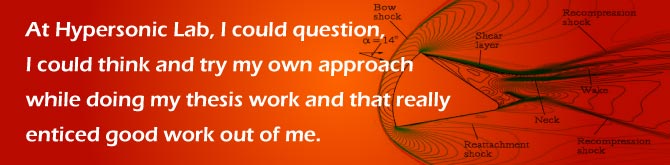
Think about what you are doing: Be thoughtful of what you are trying to do. Freedom of work is a big motivational factor in my opinion. At Hypersonic Lab, I could question, I could ask, I could think, I could suggest, try my own approach while doing my thesis work and that really enticed good work out of me.
Play around with solver codes: In my opinion, one cannot do any serious CFD work without dirtying hands with coding. The understanding that I developed by playing around with the solver codes was one of the key takeaways for me in long term. You typically don't get much time in industry to do such things.
Technical Writing: If I have to choose one thing, I would say the technical writing skill is the biggest gain for me. Writing few quality research papers along with your thesis report really gives you that extra edge where you can articulate technical things in a better way. With Sinha Sir's guidance, I learned how to express same information in much precise and concise manner. This, I feel is really important skill as you need to document whatever work you do, whether as an academic researcher or as an industrial engineer. Better hone your skills while you are in college.
Presentation Skills: This is another important skill that you should practice. This is perhaps the most important soft skill for a professional in any field.
Project Management: I find it critical to have some sort of project management in place for thesis work on personal level. Defining final goals, having milestones and some sort of timeline for them so you finish work well within time, log of work you do daily etc. helps in keeping work on track. Whichever technique works for you, use it. It's important to know that when you are working on the cutting edge of a field, it's always good to have a plan B as things don't go as planned always. I learned my lessons the hard way and but improved my approach towards as I went.
Keeping commitments: It might seem trivial but its utmost important to keep your commitments. Only commit as much as you can handle and deliver on all that you commit.
Honesty and Integrity: Frankly I did not even know the word "Plagiarism" until I got into IITB. Needless to say how important it is to have morality and integrity in your working methods. Cutting corners does not lead you too far.
Be efficient (Go Green): I always appreciated the judicious use of resources at the Lab. Be it cluster run time or printer paper or anything else. Efficiency matters. I wish everyone in industry follow similar approach and we would save a lot of resources quite easily.
These skills/factors, among other things, are essential for being successful professional person in my opinion. But ironically one do not get much time, in my observation, in industry to work on these skills for many reasons, particularly in India. Thesis work gives a good playing field to learn and hone these skills, and the opportunity should not be squandered.
Plotting in Tecplot
Posted By : Russell, Research Scholar | Posted On : Dec 31, 2014I have shared a small ppt with you on Google docs. It gives you some guidelines for a decent Tecplot figure. Now, you may ask why lay so much emphasis.
1) Sergio Pirozzoli who recently visited our lab (who also happens to review several papers including JFM) said when he gets a paper to review, his first impression is the figure quality (superfluous but important).
2) Imagine you have prepared your journal paper with 30 figures and then you realized, that the journal demands so and so line thickness, can you imagine the pain of going through all the figures all over again and re-doing those plots.
Having said that, there may be several other details I may have left out and that is the reason I shared it on Google drive. Please add to the slides to make it complete. https://docs.google.com/presentation/d/1X8uUdFFanck0wfmI3i8p9usqXivFH2VZrV6exxt96mo/edit#slide=id.p3
Experience at IUTAM conference
Posted By : Russell, Research Scholar | Posted On : Dec 21, 2014A small feedback about attending IUTAM conference, December, 2014, Goa, India.
I had a very enriching experience.
The breadth and depth to which turbulence study has spread out is beyond my imagination.
Try your best not to miss out on such opportunities. It will help you immensely to think broad and think big not only in your research but also for the rest of your career.
I was very happy with my talk although I felt the idea was very simple so am not sure if the big people present at the conference were able to appreciate it. But few students came and told me that the talk (idea) was good.
I got few comments in the Q & A session but I wish I had got more comments (both positive and negative).
I realized the value of simplifying one's talk. It is a must whether you are presenting poster, giving a oral presentation or you are a key-note speaker.
Some things regarding the talk (I may be re-iterating this)
1) It is a must not to present unnecessary material on the slide which you are not going to explain.
2) Saying two things properly is better than saying three things at a high speed.
3) Even the top guy in the room will not follow the simplest thing you say so it is a must to re-iterate things.
4) It is not the quantum of work that matters but the strength in each idea that you put forth.
5) Practicing and revising makes a huge difference.
Experience at IUTAM conference
Posted By : Ashwin Ramachandran, B.Tech Student | Posted On : Dec 21, 2014 A small feedback about attending IUTAM conference, December, 2014, Goa, India.
Adding to what Russell has written:
Most of the presentations, both by Keynote speakers and other Technical talks were aimed at solving simple and fundamental problems. Most of the talks presented were based on canonical problems. To me it appeared that there are still a lot of questions unanswered at the basic level, and these need to be tackled.
The panel discussion towards the end on the future of HPC and turbulence research brought out some important points. The one that I felt was very useful was that as researchers we need to develop skills not only theoretically, but also develop good numerical and coding skills. We should be in a position to develop a code from scratch for different problems, and then analyze the data and back it with theory. Having mentioned that, however, collaborations between specialized people in computations and theory should only play a supportive role to the entire learning process.
Another point that came up was that most of work in fluid mechanics is nowadays computational, and with the rise of the computational capabilities it is also important that we develop good analyzing skills. The computational capabilities today lead to generation of large data sets, and usually the role of computational guys end here. It is important for others to use them and analyze it, interpret them in the right way and develop the theory and understanding. Some attention needs to be given on developing these skills.
Apart from this, in general the conference was a very good learning period. A very focused set of talks together with a high quality of researchers invited were an added advantage. Overall, it was a very nice experience.
Regarding IUTAM conference
Posted By : Krishnendu Sinha, Associate Professor | Posted On : Dec 20, 2014 We had an excellent conference in Goa. There were a number of well-known researchers in the area of turbulence, and we could interact with them freely. Some of them are visiting our lab. This will give an opportunity to discuss closely with international experts.
I got to hear several good opinions about our work from the conference attendees, and this is the best reward for a researcher. I hope these interactions will invigorate our efforts towards doing world-class research and we put in some extra effort in the coming weeks.
Many of our current projects are based on good ideas, and it is up to the student to work hard and bring it to completion.
Research
Posted By : Krishnendu Sinha, Associate Professor, IIT Bombay | Posted On : 5th September 2013During the weekly Skype session (yesterday evening) with Dr. Johan Larsson @ Maryland, we were looking at the wave patterns generated behind a shock wave. Some questions were raised on how the vorticity contours look like plane waves, whereas the velocity contours do not.
The answer came out of some stuff that Amit and/or Apoorv had plotted long time back. It turns out that the velocity field is a superposition of two waves, so that the resultant does not exhibit planar wave fronts.
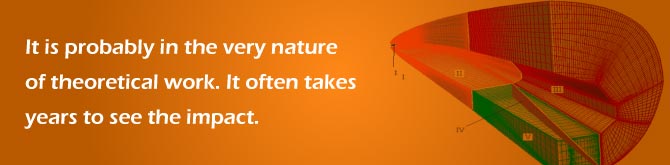
It was interesting to see how some things we did earlier are still useful. It is probably in the very nature of theoretical work. It often takes years to see the impact, and the work becomes more and more important as time passes.
Experience at Summer Program Research,TUM
Posted By : Russell Quadros, Research Scholar, IIT Bombay | Posted On : 30th August 2013Some things I would like to share with all of you that I learnt from my TUM and conference experience regarding presentation.
1) Your colour code of the entire ppt speaks a lot though it may be a subtle factor. Put attractive but not flashy/dull colors.
2) Generally I saw that the opening slide spoke a lot either about the further technical content or about the group/person/country who/which is presenting/represented.
3) Know your slides well even before you can land on them.
4) Convey maximum through figures/x-y plots and do not expect audience to read the content.
5) One figure and 2-3 bullets was generally the trend.
Experience at Lab
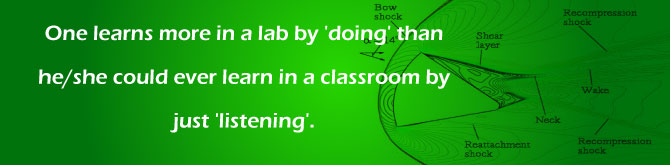
Posted By : Palash Sashittal, B.Tech. Aerospace Engineering, IIT Bombay | Posted On : 2nd June 2013My experience in the Lab has been great. It made me realize that one learns more in a lab by'doing' than he/she could ever learn in a classroom by just 'listening'. In my time in the lab, I understood what research is all about for example; it's as much, if not more, about your skill to ask the right question as it is about your skill to find the answers. This experience will definitely help me decide what I want to do for most of my remaining life. I feel every tudent should do some research work at some point in his/her tenure.
Experience at Lab
Posted By : Ashwin Ramachandran, B.Tech. Aerospace Engineering, IIT Bombay | Posted On : 31st May 2013When I first came to the lab, I had just completed the introduction course on Aerospace Engineering. During the course, the concept of Shock waves was introduced to us. I found that it's related phenomenon are very interesting and thought that I should do more than what was just covered in class. So, I approached Prof. Krishnendu Sinha who taught us the introduction course, telling him about my interests. Thereafter, I started working on Shock Turbulence Interaction and to be more precise, heat flux calculations when a shock wave interacts with a flow which is turbulent in nature. All the more motivating was the fact that Turbulence as such is also claimed to be one of the unsolved problems in physics. Initially, I picked up all the related basics from my seniors in the lab. Within a month, I was able to start participating in the regular discussions and also contributing ideas and results.
You get to work together along with Ph.D. students and work on problems which are very interesting. It is a very good learning experience and gives an exposure of what research is about and how people do research. You derive equations and also generate results by doing some basic coding and plotting. As time progresses, you start developing your own way of doing research. You learn from your mistakes. I learnt to be more systematic in my approach to any problem and not do just arbitrary and random things. I developed good writing skills by preparing my notes and report. This experience also taught me that in research, proper documentation of the work is very essential. It is in my view that anyone who takes up a certain problem as a part of the project must stay with it for a significant time, say at least a year. One semester might be to too short for being able to do new stuff, where you may land up reading all the previous work only and not be able to contribute anything new. I feel that this learning experience will definitely come of use to anyone who wants to pursue further studies and stay in the field of research.
The approach and views to the same problem might be different from the other lab mates. We work in teams and have regular and very long discussions on how to approach the problem, with regular inputs and guidance from Sir. Generally, we have a common discussion with Sir almost once a week where we discuss our progress and also get further directions. Eventually, all these discussions along with our efforts came of use when we realised that we have done significant work which can be published. From a students' point of view, this is the best that can happen on completion of a project.
Tour of the Hypersonic Wind Tunnel at VSSC
Posted By : Krishnendu Sinha, Associate Professor, IIT Bombay | Posted On : 23rd November 2012We had a tour of the Hypersonic Wind Tunnel at VSSC (ISRO), which spanned a large area with huge compressors, mammoth vacuum tanks and an amazing amount of supporting infrastructure. We also happen to see the complex operation during a test run.
Here are some details :
-- The test section is circular with 1 m dia.
-- I think they will have about 70cm of core flow without the boundary layer.
-- There are three huge spheres, 16m in dia, adding up to more than 6000 m3 of vacuum.
-- Also, 60 cylinders storing air at 300 bar and lot more.
-- The test area cross section is 1 sq. metre.
-- It is a blow down wind tunnel
-- Mach numbers upto Mach 12
-- Typical testing time of about 20 sec.
Talk on STI at ISRO
Posted By : Krishnendu Sinha, Associate Professor, IIT Bombay | Posted On : 22nd November 2012We visited the ISRO center at Trivandrum last week. We presented the scramjet inlet simulations that were done as part of ISRO sponsored projects. Kannan had put together a good presentation based on the work of Amjad, Sarvesh, Vighnesh, Nilesh, Nithiyaraj and others. Kannan can probably share the pdf with the hypersonic CFD group.
I gave a talk on our shock-turbulence research and its application in SBLI flows. It was part of their Air-breathing Propulsion Seminar series. I realized the importance of the seminar only on seeing a 100 strong audience including one of VSSC Dy. Director. They also gave a nice PSLV model at the end of the lecture. (The model was large enough to cause some concern at the Airport security check.)
The trip was long awaited, and especially relevant to past students and RAs who generated many of the results that were presented and discussed
-
 Pratikkumar Raje gave his Ph.D. Defence on "Advance two equation turbulence models for computing shock-dominated flows in aerospace applications” on 2nd December, 2021.
Read More...
Pratikkumar Raje gave his Ph.D. Defence on "Advance two equation turbulence models for computing shock-dominated flows in aerospace applications” on 2nd December, 2021.
Read More... -
A paper titled “A Weakly Nonlinear Framework to study Shock–Vorticity Interaction” authored by Pranav Thakre was accepted in Journal of Fluid Mechanics on 16th November, 2021.
Read More...
-
Prof. Krishnendu Sinha submitted a paper titled “Field experiments to identify and eliminate recirculation zones to improve indoor ventilation”, co-authored with others, on 15th October, 2021 to Transactions of the Indian National Academy of Engineering.
Read More...
-
A paper titled “Effects of recirculation zones on the ventilation of a public washroom” authored by Prof. Krishnendu sinha and co-authored with others, was accepted in Physics of fluid on 19th september, 2021.
Read More...
-
Prof. Krishnendu Sinha was awarded the “Prof. S. P. Sukhatme Excellence in Teaching Award” for the year 2020 in recognition of his merit, achievements and enthusiasm for teaching and making a lasting impression on students on 6th September, 2021.
Read More...
-
Jagdish Babu Vemula presented a paper titled, "Application of shock-unsteadiness model to interaction of transverse sonic jet and supersonic crossflow" at AIAA 51st Fluid Dynamics Conference,August 2-6, 2021, VIRTUAL EVENT.
Read More...
-
Harsha Rathi presented a paper titled, "Numerical Detection of Shock Location and Shock Strength in Unsteady Flow Computations" at AIAA 51st Fluid Dynamics Conference,August 2-6, 2021, VIRTUAL EVENT.
Read More...
-
Pratikumar Raje presented a paper titled, "Formulation of advanced SST turbulence model for shock-boundary layer interaction" at AIAA 51st Fluid Dynamics Conference, 2nd August,2021 VIRTUAL EVENT.
Read More...